Saturday, January 5, 2013

Billy Graham in Nagaland

The amount of signs with psalms, crosses, and churches in Nagaland rivals the U.S. Bible belt. In fact, it's not possible to understand how Nagaland has developed without understanding the role of Christianity. 
Here's my basic attempt to make sense of it. (Check out my friend Heather Layton's blog for a much better description of Nagaland and the role of religion here.)

Today, Nagaland is the largest Baptist state in the world; as much as 70% of the population is Baptist and over 90% is Christian. Religion is everywhere. Sunday, the city nearly shuts down as families pack into churches. Christian colleges and schools abound, and alcohol of all kinds are officially banned. Despite the alcohol ban, most Nagas find ways to access liquor through the black market. Yet politicians have avoided challenging the alcohol ban--largely because of the power of the church.

Why is Jesus so important in Nagaland? Although the Naga people originally held strong animus spiritual beliefs, Christianity reached them in the1850s when U.S. Baptists sent missionaries to these isolated hills. Nagaland’s neighboring areas of Assam had been converted into Hinduism and Burma into Buddhism, but only the Christian missionaries were up to the challenge of venturing into the remote hills of the warring Naga headhunters. 

Imagine the journey these fervent missionaries made to reach the Naga villages?! Again, Nagaland is landlocked without any navigable rivers, and the landscape is mountainous. 


Regardless, in 1839, Reverend Miles Bronson from the U.S. Baptist Church attempted to convert the Nagas who were most accessible and closest to Assam (where Baptists were already established.) He eventually failed due to illness (and probably because the Nagas rejected him). But he is still honored here in Nagaland.

Rev. Miles Bronson attempted to convert
the Nagas in 1839.

The first real and lasting contact between missionaries and Nagas was around 1869 when Rev. Dr. E.W. Clark from Boston connected with the powerful Ao tribe. In 1876 Clark established the first Christian town among the Ao tribe in a place called Molungyimsen in north-western Nagaland. By 1911, this settlement had produced the Ao-English dictionary--bringing written language to the Naga tribe for the first time. Soon after, Ao pastors began to convert other Naga tribes. From 1920 through the 1970s, Baptist evangelicals spread their word throughout Nagaland. They brought Jesus, schools and hospitals.  

Today, many Nagas credit the church for helping to unite the different tribes and for bringing classic education, English and the written language. Even among some of the artists that Mike and I have met (more on this later), Christianity is influential. It also seems that the abundance of musicians within Nagaland may have something to do with their upbringing in the Baptist Christian church.

There is no doubt that Baptists won the Naga hearts. Still today, Nagaland is the largest Baptist state in the world. In April, 2012 Billy Graham’s daughter came to speak as the Nagaland Baptist Church Council celebrated 75 years. Hailing over 600,000 members, the Baptist church claims the vast majority of Nagas.


I pulled the following statistics from the American Baptist International Ministries Website. In 2011, the Christian Baptist Convention of Northeastern India (which also includes Nagaland’s bordering states of Assam, Manipur and Arunachal) had 7,804 churches and 1,045,804 baptized members! 

What I find curious is that despite the significant role of the Christian church in everyday life here, the church seems to stay out of politics. Though the Nagas have been fighting for independence from India for decades, the Church (the heart of the Naga people) is asent from the fight. Similarly, despite an abundance of traditional Christian values in Nagaland, corruption among the political class who controls much of the state's pursestrings still abounds. 

Obviously my cursory look at Christianity in Nagaland offers few answers--but it will be fascinating to see how the church's influence changes as Nagaland continues to develop. Will it maintain its power over subsequent generations of Nagas? Will it become more political or remain quiet as the government of India and Naga liberation movements fight for a peaceful resolution?

Friday, January 4, 2013

World War II Battle of Kohima 1944


In Kohima, the capitol of Nagaland, the two largest, most beautiful public spaces have nothing to do with the Naga people. They were designed to honor British and Japanese soldiers who fought a famous WWII battle here in 1944.

If Kohima were Washington, D.C. these memorials would be like the Thomas Jefferson Memorial and the Washington Monument--at least in terms of significance to the skyline, the city plan, and even to tourists. I find this curious since the Nagas have lost as many of 200,000 people in their decades-long war for independence from India since 1947 (more on this later). Nagas also lost many warriors who fought off British soldiers before they colonized the city of Kohima in 1878. Where is their memorial? But of course, the history of western imperialism, as well as the complex, sensitive and ongoing politics of the Naga independence movement, makes a Naga civil war memorial impossible at this time.

Instead, it is common to see Naga families taking a weekend picnic in either the British World War II memorial or the Japanese memorial. Both commemorate the Battle of Kohima, a more than 3-month battle from April-June, 1944, during which British and British Indian soldiers successfully fought back Japanese forces who had entered this easternmost point of India through Burma. I am no WWII historian, but a basic Google search suggests that had the outcome been different in this Battle of Kohima, the Japanese may have advanced, claiming India and possibly more of the west.

Today, the picturesque British World War II Memorial sits where the bloodiest part of the battle occurred on the tennis court of the then British Deputy Commissioner stationed in Nagaland.


The Japanese World War II memorial is a large Catholic Church perched high on a ridge. Although the Baptist missionaries converted the largest number of Nagas and the Baptist church continues to be the most powerful influence, the Catholic Church also has followers. 

Thursday, January 3, 2013

Nagaland: Where Poinsettias Grow Like a Weed

Thanks to my mother who is quite a gardener, I have picked up a fascination with flora and fauna, and wherever I travel, I take note of what is similar and different from my native Washington, D.C. In Nagaland--literally on the other side of the globe--it has been fascinating to observe foliage. The stark, subtropical mountains of Kohima remind me of areas of Oaxaca, Mexico, which also has a similar climate of a rainy season and a very dry season. We are up higher here than in most parts of Oaxaca--so there are differences, but there are still abundant chiles, poinsettias growing wild, and the occasional banana tree or sugar cane (just to remind you that we are near the tropics:)

Poinsettias grow EVERYWHERE.
We are here during the winter, the dry season. So less is blooming. But here are some shots of the foliage. I am also including some shots from the market to give you a sense of the local produce.

Dzukou - a valley sitting on top of 8000 ft. mountains. In the summer, it if full of wild flowers.

These mountains resemble the highlands of Oaxaca and Puebla, Mexico.


Nagas boil and eat these beautiful leaves.
Nagas eat their food HOT.


Holly


Magnolia

Bouganvilla 

Hybiscus

Rhodedendum - in the mountains near Kohima, sits the largest Rohdedendrum in the world.

Skipping the Industrial Revolution: From Head Hunters to Global Entrepreneurs


In America, we talk a lot about the self-made man. The story goes that he/she grew up in a trailer park and then pulled themselves up by their own boot straps to become the CEO of a multi-billion dollar company. While no one can deny that the upward mobility of the American Dream is real--I reject the "self-made" concept. As Malcolm Gladwell writes about in Outliers, even the “self-made man/woman" had help. They were given amazing opportunities at fortuitous moments in their lives—like access to a magnet school or a dedicated family member that pushed them to pursue their talents. No one emerges from the trailer park or the gutter to elite status without fortuitous and powerful interventions.

So—how does an indigenous community completely cut off from other societies and the modern world emerge from their head hunting past to become global entrepreneurs in less than 100 years? Since spending time with a brilliant, humble and visionary community of Nagas in northeastern India, I still cannot get my mind around this society’s rapid transition from living as warriors, hunters and primitive agriculturalists just 100 years ago to progressive modernists today.

British colonizers and Southern Baptist missionaries began to reach the first tribes of Nagas in the area where Mike and I are staying around 1850. Yet many tribes remained relatively untouched by outside civilizations until the 1960s. Today, in major Naga cities like Kohima where Mike and I are staying, Nagas are launching international exchange programs, studying fashion design in London, producing animation videos for Indian VH1, and traveling, working and studying around the world.
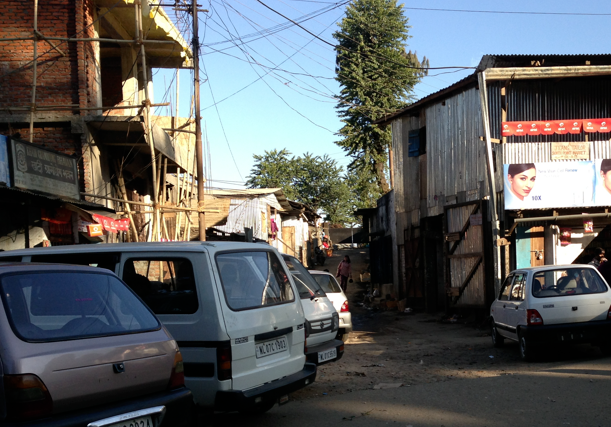
Modern Day Kohima, capitol of Nagaland, India


Computer courses are everywhere. Many Nagas have internet access through their cell phones.
Major push by Indian government to promote sustainable energy to help address water scarcity and land erosion.
No one is homeless in Nagaland. A mixture of traditional Naga family values, Christianity, and significant funding from the central Indian government keeps most of the community above the poverty line. Literacy rates have also soared from maybe 20% 30 years ago to more like 70% today (and this is from a people who up to 100 years ago had no written language.) 

Is head hunting what it sounds like? Yes. Nagas warred with other tribes and sub clans over land and resources. Each tribe had a warrior class of men who would accumulate skulls of other Naga tribes to prove their power. Those who killed women and babies--who were protected in the center of Naga villages--were considered the bravest warriors. They tattooed their bodies with pride to display the number of heads they took.


Based on the Naga animus religion, those who were murdered by Naga warriors could not rest in the afterlife until their killers were avenged. And so the Nagas were engaged in a never-ending cycle of head hunting and murder that left many tribes so concerned with issues of protection that they had little time for anything else.

As the British gained greater influence over the Nagas around the turn of the century—particularly those in the southernmost regions of what is today Nagaland—the British penalized acts of head hunters by burning down their villages and fining the Nagas. This political action was coupled with the emergence of the Southern Baptists who were quickly converting Nagas, introducing the English written language, and beginning to challenge head hunting traditions from thousands of years before.

Despite this real gradual shift away from head-hunting and towards Christianity, Nagas continued to maintain many of their traditional ways of life. And some Naga tribes remained in such remote areas of the mountains along the border with today’s Myanmar that they maintained their ancient societal traditions as warriors and head hunters through the 1960s. There was a head-hunting attack as recently as the 1990s.

So when American teenagers were spooning over the Beatles and beginning to raise their own consciousness against the Vietnam War and against segregation, racism, and sexism, these Naga tribes were wearing traditional dress, living in small villages without electricity or running water; they relied completely on their oral language.

What happens when you skip the industrial revolution on the path to modernity?
I haven't been in Nagaland long enough to have the answer to this question. And of course any answer I might find is also very specific to the customs and values of the Naga people. But there is no doubt that Mike and I are here at a major transition for the Naga people (more on their political conflict with India and the transition later).

Most Nagas over 65 grew up wearing their traditional dress and living the traditional Naga way. That generation of Nagas who were born around WWII (which had a major impact on Nagaland which I will write about later) began the process of modernization that we are seeing today. These Nagas interacted more and more with the Indian government and the outside world. While fighting and advocating for Naga sovereignty from India, they sent their children to school; they began to speak English; they united increasingly with other Naga tribes; and they began to integrate modern practice with their ancient practices that had remained untouched for thousands of year. Slowly, some Nagas began to lose touch with their ancient traditions.

Today, Naga businessmen and woman and political strongmen and woman are working within the Indian government to strengthen their communities. They are also becoming increasingly curious about their ancestry. Many of the Nagas we have met with incredible talents, abilities and possibilities to travel around the world have chosen to come back home to live and work in Nagaland. Perhaps skilling the Industrial Revolution means that Nagas skipped the community and family fragmentation that commonly took place in the West? Regardless, it seems that for the Nagas modernization has happened while maintaining a sense of community and family values. This could change with the next generation. But for now, I hope that Nagas continue to modernize and change as every society does while also maintaining their unique identity.  

Naked Warriors and Dancers: the Recent Naga Past


Mike and I recently toured the Kisama heritage village outside of Kohima that was established 12 years ago to preserve the customs--design, art, dance, festivals, etc--of the 16 Naga tribes. Every year, the government of India helps to fund the Hornbill Festival to feature the traditional music, dance, games, and artistry of the distinct Naga tribes. Sadly, Mike and I missed the festival--but here is my attempt to give a snapshot of the recent past of these 16 curious tribes that inhabit Nagaland, India.


Pre 1900
Before Nagas came into contact with the British and/or Southern Baptist missionaries between 1850-1900, the 16 Naga tribes and their many sub-clans lived in isolation from the outside world—and sometimes even from each other. They did not trade with the nearby tribes that were part of the Assam Kingdom (in what is now the Assam state of India) or the Kingdom of Manipur (now Manipur state) to the south. They were cut off from the cosmopolitan silk-road trade route. Instead, they lived in ornately carved wooden huts, hunted, cultivated rice, believed in natural spirits, weaved, made pottery, held frequent harvest festivals with music, dance, games, etc., and warred with each other, cutting of human heads and keeping the skulls (more on this later.)


The origin of how Nagas came to settle in the hills at the foothills of the Himalayas is still a mystery. The presence of sea shells on the dress of some Naga tribes has led some to wonder if the Nagas migrated long ago from an island community in southeast Asia. But how and why would an island people migrate to a landlocked area in the hills? Their features remained distinct from other nearby tribes and very distinct from the features of nearby Bengalis or Northern Indians. Nagas look more Asian with their almond shaped eyes, straight black hair.


Wood carving of Ao woman in traditional dress. The Ao tribe was in the Northwestern area of today's Nagaland.


From what archeologists know from Nagas’ oral traditions and broader study of Northeastern India, Nagas lived in isolation even among themselves. Though different tribes were separated by as little as 20 kilometers, their languages and customs were so different that they could not communicate.  Their world was small. But their world was also rich with customs, ornate festivals to promote the growing season and celebrate their warrior prowess. They carved ornate wood sculptures, wove shawls and clothing (that slightly resemble some of the works of the indigenous communities I have come to know in Peru, Mexico and Guatemala). They hollowed out larger tree trunks to make large drums that they used to communicate from far distanced. They domesticated a native Buffalo called the Mithun. They made rice beer, smoked tobacco and sometimes opium. They sang and danced. And of course, they head hunted (more on this later).  

Here are a few photos from Kisama village highlighting the way Nagas lived as recently as 50 years ago.
Our wonderful host Theja outside of Kisama Heritage Village 9 km from Kohima


Final rest at the ridge of the Mountains in Kohima, Nagaland


As most folks know, the purpose of our trip to India was for Mike to participate in an artist residency in Nagaland. Nagaland is a far eastern Indian state in the foothills of the Himalayas that borders Myanmar to the east and is still relatively unknown even to Indians.


Nagaland has a completely separate ethnic, religious and political history as the rest of India. It is made up of 16 distinct tribes (with many more sub-tribes) that until about 100 years ago lived isolated in these rugged subtropical mountains. They survived as warriors, small-scale rice cultivators and hunters with little to no trade with the Kingdoms of Assam and Manipur around them.


The Naga tribes had/have distinct dress, language and customs and lived throughout the subtropical hills and valleys of Nagaland. They are known for hunting, colorful festivals, skilled weaving, wood carving and also for "head hunting." The tribes fought frequently and the more human skulls a warrior accumulated--particularly of children and women--the more respect and power he earned.

About 150 years ago the Southern Baptist missionaries came to what is now Nagaland to convert the Naga people. (This is also about the same time that the British came to colonize this area--but I will write more on the later.) The missionaries were quickly accepted and Christianity became a powerful, unifying influence. The embrace of the southern Baptist, conservative Christian faith began a rapid process of modernization and a move away from tribal warfare. Still today, Nagaland is the largest Baptist state in the world. Religion plays an integral role in the formation of the Naga community. In fact, the word Naga (which also has an unrelated and separate meaning in the Hindu faith that worships the snake Naga spirit) only came into existence 150 years ago when the Souther Baptists came. 

So back to our journey here. On December 27, after two flights, a long layover in the loud and unpleasant Kolkata (Calcutta) airport, we landed in Dimapur, the transportation hub of Nagaland. Our lovely host, Theja, picked us up and drove us on a three-hour, windy and bumpy car ride up into the mountains where the Nagaland capitol, Kohima, sits on the ridge of green, subtropical mountains. After the grime and chaos of Delhi, the chill and confusion of Agra, and the exhaustion of the nearly 36 hours of cumulative travel time from our home in Washington, DC—it was brilliant to rest in the Nagaland hills of Kohima. 

Though we are 10.5 hours of difference from Washington, DC, the time distance is more like 12 hours (India has one time zone despite spanning nearly as wide as the U.S. from east to west.) We are literally on the other side of the world.

Here are some photos of where we are staying.


Stay tuned for more photos and posts about our Nagaland experience in coming days. (Internet is spotty. So expect delays:)