In America, we talk a lot about the self-made man. The story goes that he/she grew up in a trailer park and then pulled themselves up by their
own boot straps to become the CEO of a multi-billion dollar company. While no one can deny that the upward mobility of the American Dream is real--I reject the "self-made" concept. As Malcolm Gladwell writes about in Outliers, even the “self-made man/woman" had help. They were given amazing opportunities at fortuitous moments in their lives—like
access to a magnet school or a dedicated family member that pushed them to
pursue their talents. No one emerges from the trailer park or the gutter to
elite status without fortuitous and powerful interventions.
So—how does an
indigenous community completely cut off from other societies and the modern
world emerge from their head hunting past to become global entrepreneurs in
less than 100 years? Since spending time with a brilliant, humble and visionary
community of Nagas in northeastern India, I still cannot get my mind around this society’s rapid
transition from living as warriors, hunters and primitive agriculturalists just
100 years ago to progressive modernists today.
British colonizers and Southern Baptist missionaries began to reach the first tribes of Nagas in the area where Mike and I are staying around 1850. Yet many tribes remained relatively untouched by outside civilizations until the 1960s. Today, in major Naga cities like Kohima where Mike and I are staying, Nagas are launching international exchange programs, studying fashion design in London, producing animation videos for Indian VH1, and traveling, working and studying around the world.
 |
| Modern Day Kohima, capitol of Nagaland, India |
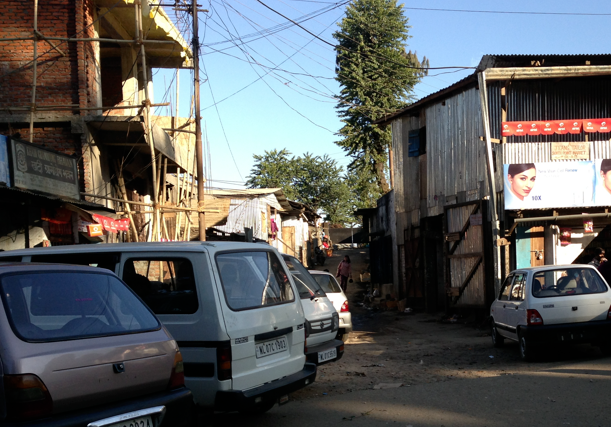

 |
| Computer courses are everywhere. Many Nagas have internet access through their cell phones. |
 |
| Major push by Indian government to promote sustainable energy to help address water scarcity and land erosion. |
 |
| No one is homeless in Nagaland. A mixture of traditional Naga family values, Christianity, and significant funding from the central Indian government keeps most of the community above the poverty line. Literacy rates have also soared from maybe 20% 30 years ago to more like 70% today (and this is from a people who up to 100 years ago had no written language.) |
Is head hunting what it sounds like? Yes. Nagas warred with other tribes and sub clans over land and resources. Each tribe had a warrior class of men who would accumulate skulls of other Naga tribes to prove their power. Those who killed women and babies--who were protected in the center of Naga villages--were considered the bravest warriors. They tattooed their bodies with pride to display the number of heads they took.

Based on the Naga animus religion, those who were murdered by Naga warriors could not rest in the afterlife until their killers were avenged. And so the Nagas were engaged in a never-ending cycle of head hunting and murder that left many tribes so concerned with issues of protection that they had little time for anything else.
As the British gained greater influence over the Nagas
around the turn of the century—particularly those in the southernmost regions
of what is today Nagaland—the British penalized acts of head hunters by burning
down their villages and fining the Nagas. This political action was coupled
with the emergence of the Southern Baptists who were quickly converting Nagas,
introducing the English written language, and beginning to challenge head
hunting traditions from thousands of years before.
Despite this real gradual shift away from head-hunting and
towards Christianity, Nagas continued to maintain many of their traditional
ways of life. And some Naga tribes remained in such remote areas of the
mountains along the border with today’s Myanmar that they maintained their
ancient societal traditions as warriors and head hunters through the 1960s. There
was a head-hunting attack as recently as the 1990s.
So when American teenagers were spooning over the Beatles
and beginning to raise their own consciousness against the Vietnam War and
against segregation, racism, and sexism, these Naga tribes were wearing
traditional dress, living in small villages without electricity or running
water; they relied completely on their oral language.
What happens when you skip the industrial revolution on the path to modernity?
I haven't been in Nagaland long enough to have the answer to this question. And of course any answer I might find is also very specific to the customs and values of the Naga people. But there is no doubt that Mike and I are here at a major transition for the Naga people (more on their political conflict with India and the transition later).
Most Nagas over 65 grew up wearing their traditional dress and living the traditional Naga way. That generation of Nagas who were born around WWII (which had a major impact on Nagaland which I will write about later) began the process of modernization that we are seeing today. These Nagas interacted more and more with the Indian government and the outside world. While fighting and advocating for Naga sovereignty from India, they sent their children to school; they began to speak English; they united increasingly with other Naga tribes; and they began to integrate modern practice with their ancient practices that had remained untouched for thousands of year. Slowly, some Nagas began to lose touch with their ancient traditions.
Today, Naga businessmen and woman and political strongmen and woman are working within the Indian government to strengthen their communities. They are also becoming increasingly curious about their ancestry. Many of the Nagas we have met with incredible talents, abilities and possibilities to travel around the world have chosen to come back home to live and work in Nagaland. Perhaps skilling the Industrial Revolution means that Nagas skipped the community and family fragmentation that commonly took place in the West? Regardless, it seems that for the Nagas modernization has happened while maintaining a sense of community and family values. This could change with the next generation. But for now, I hope that Nagas continue to modernize and change as every society does while also maintaining their unique identity.
What happens when you skip the industrial revolution on the path to modernity?
I haven't been in Nagaland long enough to have the answer to this question. And of course any answer I might find is also very specific to the customs and values of the Naga people. But there is no doubt that Mike and I are here at a major transition for the Naga people (more on their political conflict with India and the transition later).
Most Nagas over 65 grew up wearing their traditional dress and living the traditional Naga way. That generation of Nagas who were born around WWII (which had a major impact on Nagaland which I will write about later) began the process of modernization that we are seeing today. These Nagas interacted more and more with the Indian government and the outside world. While fighting and advocating for Naga sovereignty from India, they sent their children to school; they began to speak English; they united increasingly with other Naga tribes; and they began to integrate modern practice with their ancient practices that had remained untouched for thousands of year. Slowly, some Nagas began to lose touch with their ancient traditions.
Today, Naga businessmen and woman and political strongmen and woman are working within the Indian government to strengthen their communities. They are also becoming increasingly curious about their ancestry. Many of the Nagas we have met with incredible talents, abilities and possibilities to travel around the world have chosen to come back home to live and work in Nagaland. Perhaps skilling the Industrial Revolution means that Nagas skipped the community and family fragmentation that commonly took place in the West? Regardless, it seems that for the Nagas modernization has happened while maintaining a sense of community and family values. This could change with the next generation. But for now, I hope that Nagas continue to modernize and change as every society does while also maintaining their unique identity.


